• About
  • Food Photography
  • Portraiture
  • Contact
Menu

Caroline Zhang Photography

  • About
  • Food Photography
  • Portraiture
  • Contact
×
Brigadeiros | Pass the Cocoa

Brigadeiros

Caroline Zhang November 24, 2015
Brigadeiros | Pass the Cocoa

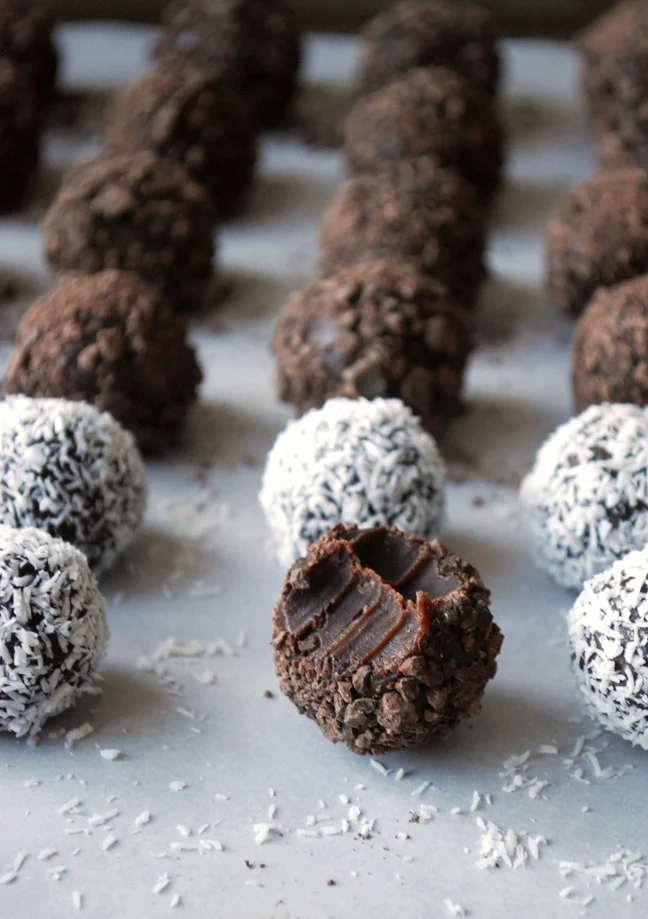
I've been nursing a particular fascination for these little Brazilian chocolate candies for a few weeks now. Brigadeiros are a Brazilian fudge truffle, made from condensed milk cooked with flavors like chocolate, almond, and coconut.

I first saw them a while back on the Youtube channel Dulce Delight (If you haven't watched Raiza's videos before, definitely check them out!), and later found a microwave version on Sorted Food, which completely sold me on them. 

There's something magical about watching a simple combination of condensed milk, chocolate, and butter turn into thick, fudgy candies in just a few motions. It's a nice reminder that very standard baking ingredients like sugar have such potential to transform in shape and flavor and texture.

Brigadeiro | Pass the Cocoa
Brigadeiros | Pass the Cocoa

These are definitely some of the easiest candies I've ever made, and just require throwing a few ingredients into a bowl and sticking it into the microwave. Shaping the brigadeiros is much easier and less messy than traditional truffles, which tend to melt all over your hands.

The texture and taste is a cross between fudge and caramel; they're slightly chewy yet melt in your mouth. Throwing in the fact that you can store them in your fridge a couple days ahead of time, I'd definitely recommend making them part of your holiday cookie platter!

Caroline


Brigadeiros

Yields: about 15 brigadeiros
Loosely adapted from Betty Crocker
Click here from the printer-friendly recipe.

Ingredients
1 can (14 oz.) sweetened condensed milk
2 ounces unsweetened chocolate
2 tablespoons unsalted butter
⅛ teaspoon salt

For Assembly
Butter, for greasing
½ cup topping, such as finely chopped semi-sweet chocolate, finely chopped nuts, finely shredded coconut, or sprinkles

Directions
Pour the condensed milk in a large microwaveable bowl. Add the chocolate and butter. Microwave on high for about 45 seconds. Take the bowl out and give the mixture a good stir.

Microwave for another 5 minutes, taking the bowl out every 2 minutes or so to thoroughly mix it. The brigadeiro mixture is done when it has become thick and fudgey, and you can pull it away from the side of the bowl when you stir it. (Your cooking time may vary by a minute or two depending on the power of your microwave). Stir in the salt. 

Spoon the mixture onto a large plate and chill for at least 3 hours, or overnight.
Shape the brigadeiros. With a spoon, scoop out about 2 teaspoons of the brigadeiro mixture. Rub a little butter into your palms, to prevent the chocolate from sticking. Roll the brigadeiro into a ball, and roll the ball in your topping of choice.

Brigadeiros keep at room temperature for about 2 days, and in the refrigerator for up to a week.


In candy Tags chocolate, no-bake, brazilian, candy, truffle, fudge, dorm food
Irish Barmbrack | Pass the Cocoa

Irish Barmbrack (Tea Cake)

Caroline Zhang November 18, 2015
Irish Barmbrack | Pass the Cocoa
A British one, is characterized
As British. But don't be surprised
If I demur, for, be advised
     My passport's green.
No glass of ours was ever raised
     To toast The Queen.
—Seamus Heaney, "An Open Letter"

I get asked a lot about why I am so fascinated with Ireland (and, standing here in the middle of senior fall with another 40 or 50 pages of thesis writing  about Irish poetry ahead, I still am). The answer I give usually is a vagary about the British Empire, and Ireland as an interesting postcolonial study.

And I have spent quite a bit of the past two years thinking about Ireland as a colonial subject and imperial actor, from spies during the Irish Civil War to policies on prostitution after independence. It sometimes has been a rather simplistic study, a delineation of some nationalist ideal of what is "Irish" and what is "British" and other, a consideration of a country supposedly still reeling from a "long colonial concussion," to borrow Seamus Deane's phrase.

But I also love this island that I've never visited because of a certain empathy it has with my own background as a second generation immigrant. I think there is a sense of in-between-ness, uncertainty, and sometimes crisis in Irish culture and history that strikes a familiar chord. (This is merely my two cents; I do not, of course, speak for the Irish people. "I'll stick to I," as Seamus Heaney says in his poem).  There is the question of losing a national language, of struggling for intellectual autonomy from a presence that has for so long been intertwined with one's own identity.

These themes certainly aren't unique to Ireland, and I'm not sure why I'm not studying someone who looks more like I do. But Ireland has been a literary and intellectual focal point for me, and will continue to be so, at least until I get that thesis in.

Irish Barmbrack | Pass the Cocoa

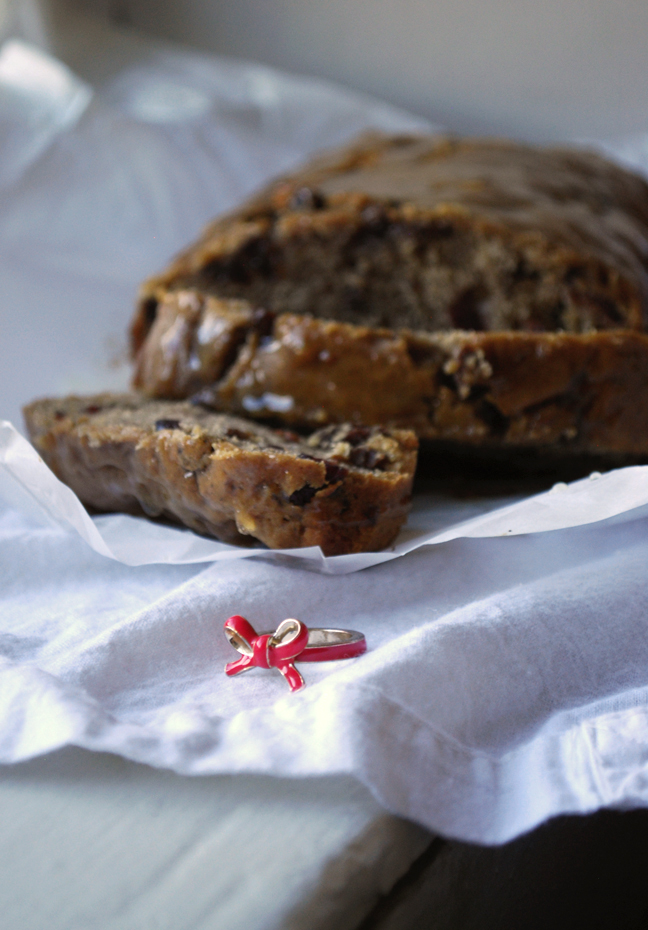
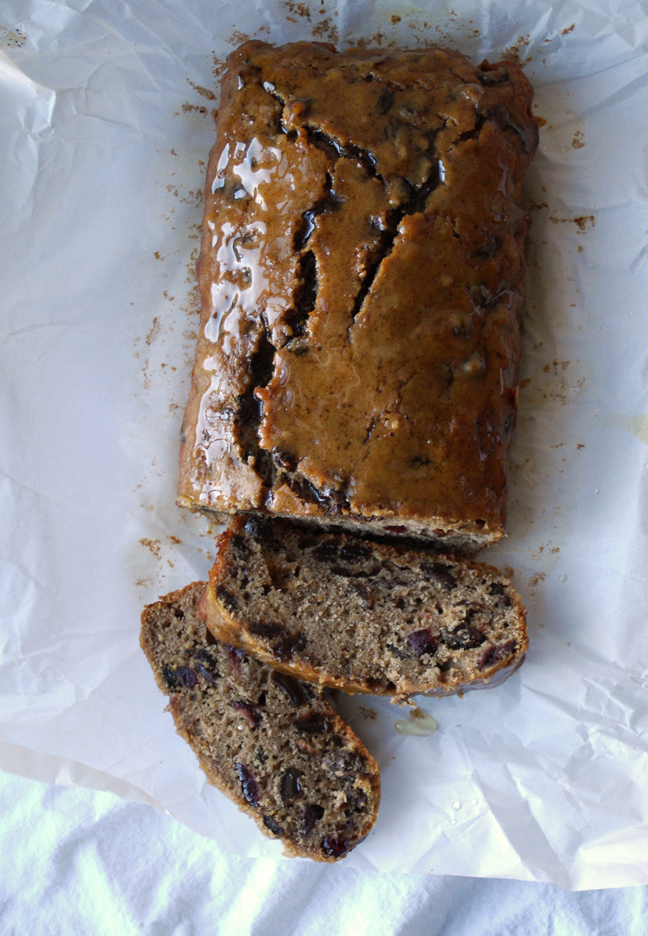
I'm going to hold off on all the jokes about Irish food I could be making right now, and just tell you about this tea bread. It's a spiced cake usually made in autumn, and is flavorful, moist, and dense. Traditionally, you add a ring to the batter, and the person whose slice of cake contains the ring will be the first person to get married. (I held off on the ring though, since I didn't want my friend to break a tooth when I shipped the cake to her). 

Unlike most tea breads, this one actually contains a hefty amount of black tea in the batter itself, rather than being simply cake served with tea. Use Irish breakfast tea, if you can get your hands on it; it's rather stronger than traditional black tea. 

I used English tea, and felt rather treasonous about it...

Love,
Caroline


Irish Barmbrack

An Irish tea cake featuring the flavors of autumn

Click here for the printable recipe.
Loosely adapted from
Saveur
Yields: one 9x5 loaf (about 8 servings)

Ingredients
1 cup raisins or dried currants
½ cup dried cherries or cranberries
1 ½ cups strong black tea, cooled
4 tablespoons candied citrus peel (you can substitute 1 tablespoon freshly grated orange zest)
¼ cup dark brown sugar
1 egg
1 egg yolk
⅓ cup vegetable oil
1 teaspoon ground cinnamon
¼ teaspoon nutmeg
¼ teaspoon ground cloves
2 cups all-purpose flour
2 ½ teaspoons baking powder
¼ cup honey
1 tablespoon hot water

Directions
Combine the dried fruit, black tea, and citrus peel in a large bowl. Let sit for about two hours, so that the fruit re-hydrates and absorbs the tea.

Preheat the oven to 350 F. Grease a 9x5x3 inch loaf tin with vegetable oil. (Or line the tin with parchment paper). 

In a large mixing bowl, whisk together the brown sugar, egg, egg yolk, and vegetable oil. Mix in the dried fruit and peel along with the tea they have been soaking in. Mix in the spices, followed by the flour and baking powder.

Pour the batter into the loaf tin, and bake for about 40 to 50 minutes, or until a skewer inserted into the center comes out clean. 

Mix together the honey and hot water, and pour it over the top of the cake while it is still warm. Let cool for at least 15 minutes. Cut some generous slices and serve


In cake, bread Tags cake, bread, tea, quick bread

The Ischler

Monica Cheng September 21, 2015

If there is one cookie that could be the emperor of all cookies, it would be the Ischler.

The Ischler is an elegant little Austrian cookie and there are a few variations on it, but in this version it is essentially a pairing of dark chocolate and apricot sandwiched between soft almond cookie layers. This is Rose's recipe which can be found in The Baking Bible. The thin layer of apricot lekvar accents the chocolate and almond, giving the cookie a "pop!". The cookie itself has a texture that is a cross between marzipan and shortbread. Using unblanched almonds gives the cookies a lovely flecked appearance, and helps to bring out the nutty almond flavor.

This cookie does require a bit of time and planning, but the results are totally worth it. These are especially great as birthday treats and, I would imagine, for other special occasions as well. Ischlers are traditionally a bit smaller than the ones I made, and would look adorable with scalloped edges (if you have the right cookie cutter). In my case, a glass cup worked just as well as a makeshift cookie cutter.

Love,
Monica


The Ischler

Recipe from The Baking Bible

Ingredients
For the cookie dough:
2 sticks (1 cup) butter, cold
1 cup + 2 tablespoons powdered sugar
2 cups unblanched almonds
1/2 egg (1 tbsp + 1 tsp), lightly beaten
1 teaspoon pure vanilla extract
1 3/4 cup + 1 tablespoon all-purpose flour


For the apricot lekvar filling:
2 2/3 cups (1 lb) dried apricots
2 cups water
1 cup + 2 tablespoons granulated sugar
2 teaspoons lemon zest


For the dark chocolate ganache filling:
8 oz (1 cup) bittersweets chocolate (60% cocoa)
1/4 cup heavy cream

Directions
For the cookie dough:
Cut butter into 1/2 inch cubes. Butter should be cool but soft enough to press flat.

Process powdered sugar and almonds until almonds are very fine. Add butter, and process until smooth & creamy. Add egg and vanilla. Add flour. Mixture should be moist & crumbly particles and hold together if pinched. Divide into quarters (4 dough discs) and chill in plastic wrap for 2 hours.

Prepare baking sheet by lining with parchment paper.

After chilling, set dough disc on lightly floured surface. Let dough soften for 10 minutes, or until malleable enough to roll. Roll dough to 1/8 inch thickness.

Cut out twenty 2.25 inch cookies. Set each 1/2 inch apart on prepared baking sheet. Set aside scraps covered in plastic wrap to knead together with scraps from next batches.

Bake at 350F for 6-10 minutes, or until just begin to brown at edges. While baking, remove next dough disc from refrigerator to soften. Repeat the process.

For the apricot lekvar filling:
In medium saucepan, combine dried apricots and water and let sit for 2 hours to soften.

Bring water to boil, cover pan tightly, and let simmer for 20 - 30 minutes on lowest heat until apricots are very soft when pierced with skewer. If water evaporates, add extra.

In food processor, process apricots, sugar, and lemon zest until smooth. Scrape mixture back into saucepan and simmer, stirring constantly (to prevent scorching) for 10 - 15 minutes, or until deep orange in color and very thick. when lifted, a tablespoon should take 3 seconds to fall from spoon.

Cool completely. You will need 2/3 cup for this recipe. The remaining can be refrigerated indefinitely.

For the dark chocolate ganache filling:
Heat/microwave chocolate & heavy cream and stir until smooth. Mixture should drop thickly from spatula.

Assembly:
Pipe/spread a 1/8 inch layer of chocolate ganache onto half of the cookies. Spread a thinner layer of apricot lekvar onto the other half of the cookies. Assemble the two halves together.

Storage:  airtight room temperature for 5 days or frozen 6 months.


In cookie Tags austrian, cookie, cutout, chocolate, apricot, viennese
Tiramisu | Pass the Cocoa

On Tiramisu, and Our Neurotic Food Culture

Caroline Zhang August 31, 2015
Tiramisu | Pass the Cocoa

This is something of an existential piece. 

You might have noticed that it's been a while since I've posted regularly. There's the usual excuses (i.e. school, thesis research, my cookie sheet couldn't fit into the tiny summer dorm oven), but to be honest, I've had some doubts about continuing to food blog. I still love the baking, the photography, the wonderful bloggers I've met, and the excitement of sharing and finding new recipes. But then there's the massive social media pushes, the fact that these posts aren't really about the experience of creating food, the pressure to cook on trend, to create new or innovative or seasonal recipes, the strings of SEO-friendly buzzwords. And it makes me wonder what this blog is really contributing to.

A friend was talking about how much Food Network she watched: "If you gave me a set of ingredients, I could tell you exactly what a professional chef would do with them, even though I couldn't do any of it myself." We (and, I think, us millennials especially) spend so much time thinking and posting about food, yet so little actually preparing it and working with it ourselves.

Somewhere along the way, we seemed to have forgotten the that food is humble, cooking is approachable and, actually, terribly ordinary. To borrow a phrase from Michael Pollan, we seemed to have developed a sort of national eating disorder. We pick up our phones before our forks at restaurants, we spend hours in the living room worshiping celebrity chefs yet hardly set foot in the kitchen, we neurotically dash around an unfamiliar city looking for That One restaurant on Yelp with the five stars.

Tiramisu | Pass the Cocoa

And I think we food bloggers have contributed to that look-don't touch mentality towards cooking as we work to make our food look immaculately delicious. We try so hard to create styled, edited, and Pinterest-ready photos, flooding social media feeds with beautiful posts that, intentionally or unintentionally, seem just  a little unachievably perfect (Well, some of us are much farther from "unachievably perfect" than others...)

Of course, I'm not accusing food bloggers of, well, actively promoting unrealistic standards of food beauty (though if you think about it, we are rather like the fashion magazines of food, staying a season ahead, publicizing the trends, carefully editing our shiny photos). But what we do is symptomatic of this generation's rather unhealthy relationship with food. Paradoxically, cooking and food are both over-hyped yet under-appreciated. They have somehow become a part of our social media identities, yet all this food culture has somehow made us forget the humble labor of providing nourishment itself. 

This isn't a sermon or a call to action, merely me just wondering out loud. I do plan on sticking around on this here blog (plus I just renewed my Squarespace payments, so...), but as I plan the next few posts, I am trying to focus on sharing what I genuinely feel like eating. It's a consideration that sometimes gets lost in the need to always be making something new, something with pumpkin spice (ick, fall is coming, you guys...), something to fill a gap in the recipe index, something that would look good on Instagram. I forget sometimes to enjoy my food.

Tiramisu | Pass the Cocoa

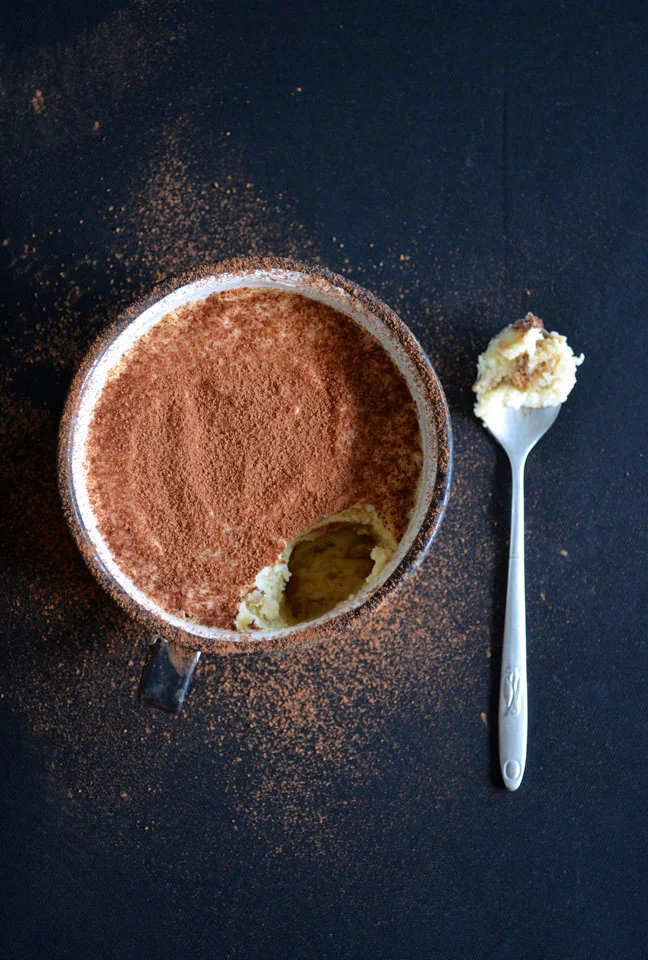
To that end, I think tiramisu is a pretty good place to get started, not least because it translates to "pick me up" from Italian.  It's gone out of fashion a little bit since it was first introduced in the 60s, losing its novelty and becoming rather overdone. There's millions of recipes for tiramisu on the Internet, and mine isn't unique at all, but I wanted to share because I love it. Tiramisu is delicious and satisfying yet humble, in terms of presentation and assembly.

My first food blog post ever was about a tiramisu-flavored cheesecake. I didn't post the recipe (which included Cool Whip...) on my high school newspaper food blog, but a friend  on staff liked my terrible picture enough to ask for the recipe. She went on to make the tiramisu cheesecake, sending us photos, and posting her own takes on tiramisu.

That embarrassingly blurry and over-corrected photo is a reminder of what I love most about food blogging, of the ability to inspire others to get into the kitchen and start experimenting. We all love seeing the magazine-ready photos, speaking like food critics about mouthfeel and richness and paired flavorings, watching videos of professional chefs deftly handling delicate patisserie. But in the end, they all tell a simple story about people, a story about feeding others and creating enjoyment and nourishment through food.

So go pull out these ingredients from your pantry, and treat yourself to some tiramisu. I really do mean it.

Caroline

Tiramisu | Pass the Cocoa

Classic Tiramisu

Click here for the printer-friendly recipe
Yields: 5-6 servings
Ladyfinger recipe adapted from Martha Stewart, tiramisu recipe adapted from The New York Times

Ingredients
For the Tiramisu24 savoiardi, or Italian ladyfingers (recipe below)
3 eggs, separated
¼ cup granulated sugar, divided
2 tablespoons Marsala
8 ounces mascarpone cheese (see notes)
1 cup espresso, cooled
1 tablespoon cocoa powder, for dusting

For the Savoiardi
½ cup all-purpose flour
2 tablespoons cornstarch
¼ teaspoon salt
3 eggs, separated
½ cup granulated sugar, divided
¼ cup powdered suga

DirectionsMake the savoiardi. Preheat the oven to 325 F. Line two large cookie sheets with parchment paper. Sift the flour, cornstarch, and salt over a piece of wax paper. 

Whisk together the egg yolks with ¼ cup of granulated sugar until the yolks become a very pale yellow and double in volume. Fold in the dry ingredients.

Add the egg whites and remaining ¼ cup of sugar to a mixing bowl and whisk until stiff peaks form. For best results, start whisking with the electric mixer set on low speed, and gradually increase speed.

Fold about ⅓ of the egg whites into the egg yolk/flour mixture to lighten. Fold in the remaining egg whites, until just combined. 
Spoon the batter into a piping back. Pipe fingers about ½ inch thick and 4 inches long. Sift powdered sugar over the cookies, and let sit for 1-2 minutes until the sugar dissolves, then sift again and let the sugar dissolve again. 

Bake the cookies for 25-30 minutes, rotating the cookie sheets halfway through, until golden brown and crispy. Let cool completely.

Make the tiramisu filling. Whisk the egg yolks with 2 tablespoons sugar until they have tripled in volume and become a very pale yellow. Add the Marsala; whisk for 3-5 minutes until pale/thick. Add mascarpone. 
In a clean bowl, mix together the egg whites and remaining 2 tablespoons of sugar. Whisk until stiff peaks form.

Fold about ⅓ of the egg whites into the egg yolk/mascarpone mixture to lighten. Fold in the remaining egg whites, until just combined. 

Assemble the tiramisu. Pour the espresso in a shallow bowl. Quickly dip the ladyfingers in the espresso and line them along the bottom of a 9x5 inch loaf pan, or individual containers.

Spread about half of the mascarpone filling over the ladyfingers, and top with another layer of espresso-dipped ladyfingers. Spread the remaining filling on top. Refrigerate the tiramisu for at least an hour, or overnight. 

Dust with cocoa powder and serve.

Notes
This recipe does contain raw eggs. Consuming undercooked eggs carries the risk of food-born illness. While the risks of consuming raw eggs are usually minimal, do be careful in your preparation and to whom you are serving. 

Mascarpone is generally found with the specialty cheeses at the grocery store, rather than with the milk and cream cheese. 


In custards and puddings, cake, pastries Tags tiramisu, coffee, mascarpone cheese, on blogging
← NewerOlder →

Search Posts

Post Archive
  • "easy"
  • "breakfast"
  • "chocolate"
  • "cookie"
  • cake
  • cookie
  • "fruit"
  • "summer"
  • "bread"
  • "Cheesecake"
  • "Oreo"
  • "dessert"
  • "fancy"
  • "Cake"
  • "blueberry"
  • pie
  • "cinnamon"
  • savory
  • breakfast
  • "berry"
  • "brownie"
  • "cupcake"
  • "holiday"
  • "nutella"
  • bars and brownies
  • "apple"
  • "birthday"
  • "pastry"
  • "pie"
  • "scone"
  • bread
  • candy
  • cheesecake
  • "banana"
  • "biscuit"
  • "citrus"
  • "ganache"
  • "lemon"
  • "macaron"
  • "muffin"
  • "strawberry"
  • "vegetable"
  • "almond"
  • "buttercream"
  • "cake mix"
  • "cranberry"
  • "cream cheese"
  • "frosting"
  • "glaze"
  • "healthy"
 

Powered by Squarespace